Gokyo Valley Trek

A nicely created paradise by natureratingbased on 5 reviews
  • Duration14 Days
  • Difficulty Level Strenuous
  • Activity Trekking/Hiking
  • Max. Altitude 5360 meters/ 17585 feet.
  • Starts Lukla
  • Ends Lukla
  • Group Size 1-12
  • Best Season March to May & September to November
Group Discount Prices
  
1 paxUS$1490
2 - 3 paxUS$1290
4 - 7 paxUS$1245
8 - 12 paxUS$1190
Gokyo Valley Trek Highlights
  • Enjoy a breathtaking flight from Kathmandu to Lukla, witnessing dramatic Himalayan views.
  • Trek through the beautiful Dudh Koshi River valley and climb into the heart of the Sagarmatha National Park.
  • Pass through iconic Sherpa settlements such as Namche Bazaar and rustic villages like Dole, Machhermo, and Gokyo.
  • Immerse yourself in Sherpa culture and traditions, including monasteries, local festivals (such as Lhosar, Dumji, Mani Rimdu in the region), yak‑pastures, and mountain-village lifestyles.
  • Get the opportunity to visit the Khumjung monastery.
  • Visit the stunning glacial lakes of the Gokyo Valley, including Gokyo Lake (around 4,790 meters) and the other turquoise lakes fed by the Ngozumpa Glacier.
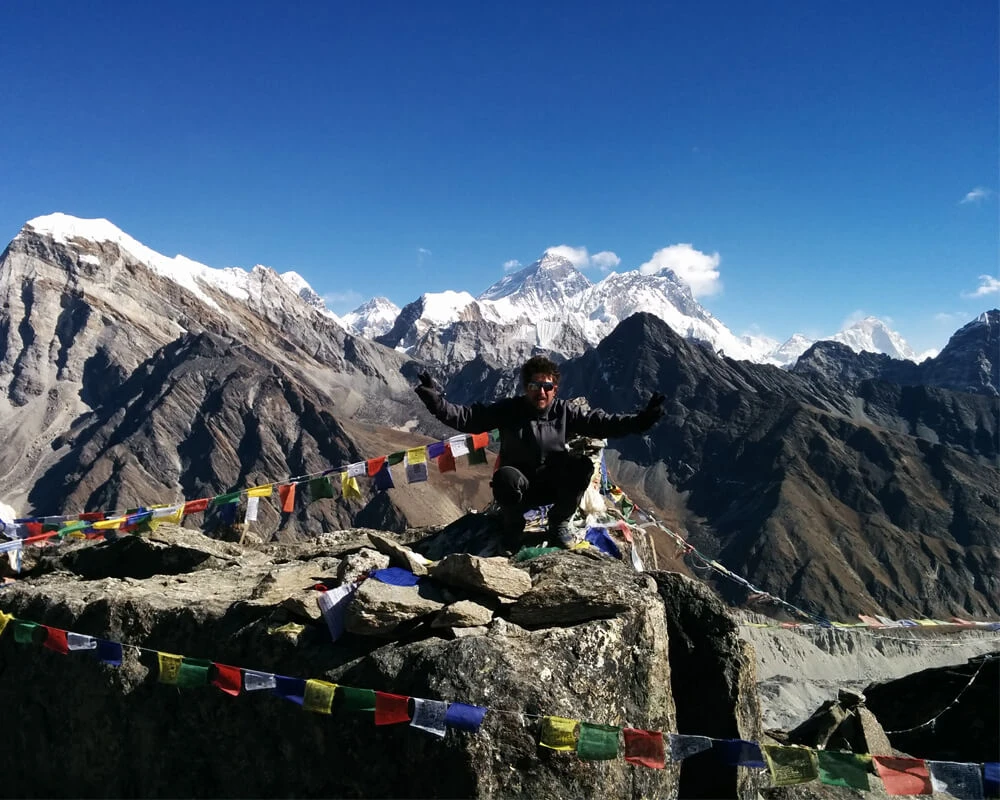
  • Climb up Gokyo Ri (approx. 5,360 meters) with 360° panoramic views of the world’s highest Himalayan peaks, including Mount Everest, Lhotse, Cho Oyu, and Makalu. 
  • Cross the high pass route via Renjo La Pass (5,340 meters / 17,520 feet).
  • Witness panoramic views of majestic Himalayan peaks such as Ama Dablam, Thamserku, Pumori, Nuptse, Everest, Makalu, Cho Oyu, Lhotse, and many more.

What Is Gokyo Valley Trek In Nepal?

Gokyo Valley Trek is a journey through Sagarmatha National Park, a UNESCO World Heritage Site, that offers all the drama of Everest’s scenery without the crowds of the classic EBC route. It’s an immersive 12 to 14 day trek that takes you through lush forests, vibrant Sherpa villages, and right up to the shimmering turquoise Gokyo Lakes, situated at around 4,790 meters. This particular route stretches roughly 110 to 120 kilometers.

Your Gokyo journey kicks off with a thrilling mountain flight from Kathmandu to Lukla, which is one of the most scenic flights in the world. From there, you follow trails that lead through Phakding and Namche Bazaar, the lively Sherpa hub. After a day to acclimatize in Namche, the path winds past Dole and Machhermo, climbing gradually toward the ethereal Gokyo Valley. Here, you walk alongside the mighty Ngozumpa Glacier, the largest glacier in the Himalayas, and even witness the unreal reflection of Cho Oyu in the surface of Gokyo’s third lake.

Now,one of the major highlights of this adventure is the Gokyo Ri (5,360 meters). This viewpoint rewards you with a 360° panorama of the world’s tallest peaks: Everest, Lhotse, Makalu, Cho Oyu, and more. After soaking in the views, you then descend via Renjo La Pass (5,360 meters), which adds a wild, adventurous twist during the trek. Here onwards, the trail then links to Lunde and loops back toward Namche and Lukla.

Along the way, you also pass through centuries-old Buddhist monasteries, spin prayer wheels beside colorful mani walls, and maybe even witness local festivals like Lhosar, Mani Rimdu, or Dumji

All in all, this Gokyo Valley Trek in Nepal is perfect if you crave a high-altitude adventure with fewer crowds, raw landscapes, and rich cultural encounters. And if you are looking for more adventure, you can extend the adventure by crossing Cho La Pass (5,420 meters) to join the Everest Base Camp trek or loop back through Renjo La Pass.

What Makes The Trek To Gokyo Valley In Nepal Unique?

The Thrilling Mountain Flight to Lukla

The mountain flight from Kathmandu to Lukla, the legendary gateway to the Everest region, is an adventurous start to your Gokyo Trek. You board the plane early in the morning, when the skies are clear and the Himalayan winds are still gentle. The plane takes off from Tribhuvan International Airport and heads straight into the heart of the mountains. 

The journey is short, just 30 to 40 minutes. During the flight, you get aerial views of deep valleys, lush ridges, and the Dudh Koshi River. This flight lands at Lukla’s Tenzing-Hillary Airport (2,845 meters), which is one of the most thrilling and challenging airstrips in the world

Pro tip: grab a window seat on the right side of the plane (facing northeast) for front-row views of the Himalayan giants, such as Everest, Lhotse, Cho Oyu, and Makalu.

Authentic Sherpa Culture in Namche Bazaar

Perched at 3,440 meters in the Khumbu region of Nepal, Namche Bazaar is the soul of the Everest region. Known as the Gateway to Everest and the beating heart of Sherpa culture, this amphitheater-shaped village is situated between the slopes of the Sagarmatha National Park, a UNESCO World Heritage Site. The moment you arrive at Namche, the mountain air feels different with prayer flags fluttering in the wind and the quiet hum of trekkers sharing space with locals.

From Namche’s ridges, you are treated to stunning views of Kongde Ri (6,187 meters) and Thamserku (6,608 meters), and on a clear morning, you may even see Mount Everest, Lhotse, and Ama Dablam. The village itself is a maze of cozy tea houses, bakeries, and colorful shops. If you arrive in Namche Bazaar on Saturday, you get to enjoy the famous local market, where locals and traders from nearby valleys gather to barter over goods.

On top of it, you also get to witness the everyday life of the Sherpas, who are renowned for their mountaineering skills, deep spirituality, and warm hospitality. While here, you can take time to explore the Sherpa Culture Museum as well. 

Sacred Gokyo Lakes at High Altitude

Situated between 4,700 and 5,000 meters in Nepal’s Everest region, the Gokyo Lakes are one of the highest freshwater lake systems in the world. It consists of a chain of six main lakes, including Gokyo Cho (Dudh Pokhari), Thonak Cho, and Gyazumpa Cho, with the backdrop of glaciers, rugged moraines, and snow-draped peaks. 

But beyond the breathtaking beauty, the Gokyo Lakes hold deep spiritual significance. For centuries, the Gokyo Lake has been revered by both Hindu and Buddhist pilgrims and is believed to be the sacred abode of Nag Devata, the Snake God. Every year, during the Janai Purnima full-moon festival, devotees climb all the way up to these heights to take a holy dip in Dudh Pokhari. This particular ritual is said to wash away sins and bring blessings. 

Ecologically, the Gokyo Lake system is fed by glacial melt from the Ngozumpa Glacier, and the lakes serve as a crucial freshwater reservoir for alpine wildlife and rare flora in this fragile high-altitude ecosystem. 

Gokyo Ri Viewpoint For 360° Himalayan Vistas

Gokyo Ri is a rugged summit rising 5,357 meters / 17,575 feet above sea level. Perched just west of the Ngozumpa Glacier, the largest glacier in Nepal, this viewpoint offers a 360° Himalayan panorama of Mount Everest (8,848 meters), Lhotse (8,516 meters), Makalu (8,463 meters), and Cho Oyu (8,201 meters) with turquoise Gokyo Lakes below.

The climb from Gokyo village usually begins before dawn. The trail winds along rocky moraines and thin air, taking anywhere from 2 to 4 hours depending on your pace. Once at the top of the viewpoint, you get to watch the first light of sunrise spill across Everest.

Unlike the crowded Kala Patthar viewpoint on the Everest Base Camp Trek, Gokyo Ri feels quieter, more personal, and somehow more spiritual. While at the top, you can linger in silence, witness the moraine ridges below, and spot the distant trails you have crossed to get here. 

Diverse Landscape, Flora, & Fauna

One of the best things about the Gokyo Valley Trek in Nepal is how dramatically the landscape transforms as you gain altitude.You start off walking through lush rhododendron and pine forests around Phakding and Namche Bazaar (roughly 2,600 to 3,500 meters), alongside hemlock, fir, birch, and juniper. If you are trekking in spring, the hillsides light up with the pink and red blooms of rhododendrons, which are Nepal’s national flower.

As you climb higher toward Dole and Machhermo, the scenery subtly shifts. The trees thin out and give way to alpine meadows scattered with juniper shrubs, dwarf rhododendrons, and hardy mountain grasses that can survive the thin air. The colors fade from lush green to golden and grey.

Above 4,000 meters, the trail becomes wilder. You find a mix of rocky moraines, glacial streams, and bare slopes. In the meantime, you also pass by the enormous Ngozumpa Glacier, the longest glacier in Nepal, and eventually reach the shimmering Gokyo Lakes.

Now, if you are lucky, you might spot wildlife such as a Himalayan tahr, musk deer, snow leopard, and red panda, though sightings are extremely rare. The skies are alive with Himalayan monals (Impeyan pheasants) along with snow cocks, blood pheasants, and alpine choughs.

14-Day Gokyo Trek Cost For 2026/2027

The standard package for the Gokyo Valley Trek in 2026/2027 costs around USD 1,490 per person. This price covers your accommodation, meals, licensed trekking guide, bus transportation, and all necessary permits within the Sagarmatha National Park region. 

Of course, there are a few things the package doesn’t cover, which mostly include your personal choices. For instance, porter hire, tips for your guide or porter, hot showers, or charging devices are not included in the standard cost. With Nepal Trekking Experts, you can always customize your journey with such personal changes at any time. Apart from this, it is also wise to carry an additional USD 200 to 300 for extra comfort, emergencies, or souvenir shopping.

Now, prices can vary slightly depending on the trekking season. Peak trekking season, such as spring and autumn, tends to be in higher demand, but the overall Gokyo Trek cost remains affordable compared to the experience it delivers. Also, if you are planning for these seasons, you must book your Gokyo Trek early.

So, if you have been dreaming of peaceful trails away from the Everest Base Camp crowds, this is your sign to plan ahead for the Gokyo Valley Trek 2026/2027.

Required Permits For Gokyo Trekking Adventure

Before you lace up your boots for the Gokyo Valley Trek, you must get your trekking permits. They are your official access to the Sagarmatha National Park and the Khumbu region. Also, your permit fees go right back into protecting the Himalayan trails and supporting the people who live in the Everest region.

For the Gokyo Trek, you need two main permits:

  • Khumbu Pasang Lhamu Rural Municipality Entrance Permit: It costs you NRs 3,000 per person. This local government fee is collected in Lukla as you begin your trek. 
  • Sagarmatha National Park Entry Permit: It costs you NRs 3,000 per person. This permit grants you entry into Sagarmatha National Park, a UNESCO World Heritage Site.

Getting these permits is simple. If you are trekking with a registered local company like Nepal Trekking Experts, both permits are already included in your Gokyo Trek package cost.

How Difficult Is The Gokyo Valley Trekking Route?

The Gokyo Valley Trek is a moderately challenging journey. The trail itself doesn’t demand technical experience, but you need good stamina, mental grit, and respect for high altitude.

During this journey, you walk around 5 to 7 hours a day, depending on the section. Early on, the route feels friendly, winding through forests, crossing suspension bridges, and passing through cozy Sherpa villages. But as you gain altitude, the terrain shifts to rugged, rocky paths and steep ascents, especially near Gokyo Ri. Higher up, the trail cuts through glacier moraines and windy ridgelines with thin air.

Similarly, the altitude and weather during the Gokyo adventure also set up a challenge. You may find temperatures drop sharply at night, winds can bite during the day, and even as seasoned trekkers, you may feel the effects of altitude. Having said that, if you are in good shape, enjoy long walks, and don’t mind the occasional uphill battle, this trek is absolutely doable.

Altitude Sickness During Gokyo Lake Hiking

If there is one thing you should take seriously on the Gokyo Lake Trek, it’s altitude. Once you climb above 3,000 meters, your body starts noticing the thinner air, and by 3,500 to 4,000 meters, the risk of altitude sickness (AMS) becomes real. Here, altitude sickness can creep up on anyone, no matter how fit or experienced you are.

Symptoms usually appear within a few hours of reaching a higher camp, and the symptoms may include headache, fatigue, nausea, loss of appetite, dizziness, or shortness of breath even while resting. These are your body’s ways of saying, “slow down and acclimatize.” If you ignore them, things can turn serious fast, leading to HAPE (fluid in the lungs) or HACE (swelling in the brain).

Therefore, the best defense is to ascend gradually and listen to your body. The Gokyo route is actually well-designed for acclimatization, with rest days in key spots like Namche Bazaar and Gokyo. You must stay hydrated, avoid alcohol, eat well, and trek at a steady pace to help your system adjust naturally to the altitude.

When Is The Best Time & Season For The Gokyo Valley Trek In Nepal?

The best time to trek the Gokyo Valley in Nepal is during the spring (March to May) and autumn (September to November) seasons. In spring, you find blooming rhododendrons and warmer, stable weather with excellent Himalayan views. Autumn brings the clearest skies, dry trails, and crisp mountain air, which is perfect for capturing the snow‑draped peaks of Everest, Lhotse, and Cho Oyu in all their glory. 

Trekking To The Gokyo Valley In Spring

Trekking to the Gokyo Valley in spring (March to May) is like stepping into a Himalayan dream. You see rhododendrons burst into bloom and the skies are crystal-clear, framing majestic giants like Mount Everest and Cho Oyu with perfect clarity.

March (Beginning Of Spring)

  • March marks the first indication of spring’s approach within the Everest area.
  • You should expect winter’s residual cold and the initial signs of spring, as more light and warmth as days progress. 
  • Mornings and evenings remain quite cold, particularly at higher altitudes.
  • At upper elevations, the trails are often still blanketed with snow or icy remains from winter.
  • The weather in March tends to be clear and crisp, with spectacular views of the giant Himalayan mountains.
  • The trekking trails in March experience fewer crowds compared to peak spring months (April/May).

April (Peak Spring Month)

  • April is regarded as the peak spring month for the Gokyo Valley Trek.
  • Expect temperate weather with sunny days and pleasantly cold nights.
  • The trails at lower altitudes are typically open, dry, and safe, though at the higher elevations, there can still be patches of leftover snow and icy sections.
  • Clear skies with spectacular Himalayan vistas and wide-angle mountain views due to low humidity and minimal haze.
  • Along the route, rhododendron forests and spring flowers begin to bloom, especially in the lower and mid-elevation zones. 
  • The air in April is crisp and sharp, providing excellent visibility of peaks and glaciers.
  • Although April is the most popular spring month, with a higher crowd.
  • Longer daylight hours and more stable weather patterns.

May (End Of Spring)

  • May marks the end of spring on the Gokyo Valley Trek, offering relatively warm days, cool evenings, and comfortable trekking conditions.
  • Trail conditions are clear and dry, with easy-to-walk routes at lower and mid-altitudes.
  • Calm weather, extended daylight hours, and bright blue skies.
  • Lush green forests and dense foliage line the trail.
  • Wildlife is more active in May, with sightings of Himalayan thar, musk deer, pheasants, and alpine birds becoming more common in the Sagarmatha National Park.
  • Temperatures are pleasantly warm during the day, especially in lower altitudes, but nights and early mornings remain crisp and chilly.
  • The Himalayan panoramas of Everest, Lhotse, Makalu, Cho Oyu, and surrounding peaks remain clear, though light haze may occasionally appear as the month progresses.
  • Light rain showers may occur towards the end of the month.
  • Fewer crowds compared to April.

Trekking To The Gokyo Valley In Autumn 

Trekking to the Gokyo Valley in autumn (September to November) is like stepping into a Himalayan postcard. After the monsoon has washed everything clean, the skies turn blue, and the mountain views have sharp clarity. The trails are dry, stable, and comfortable, with crisp daytime temperatures.

September (Beginning Of Autumn)

  • September marks the beginning of autumn for the Gokyo Valley Trek.
  • Temperatures at lower elevations are warm and comfortable, while higher-altitude areas like Gokyo, Machhermo, and Renjo La Pass begin to feel cooler and crisp.
  • Landscapes are freshly washed by the monsoon, presenting crystal-clear mountain views, vivid green valleys, and dust-free trails.
  • Waterfalls, rivers, and streams are at their most powerful, fueled by the monsoon.
  • The Gokyo region in September is surrounded by lush greenery and wildflowers.
  • Clear skies dominate from mid to late September.
  • There may still be light rainfall during early September.
  • Trails are quieter compared to the peak October season.

October (Best Month of The Year)

  • October is the best month of the year for the Gokyo Valley Trek.
  • Expect the most stable and predictable weather, with dry trails, minimal rainfall, and mild temperatures.
  • Days are warm and pleasant at lower altitudes, while mornings and nights are cool to cold.
  • Crisp, clear skies offer spectacular Himalayan vistas, allowing trekkers to see Everest, Lhotse, Makalu, Cho Oyu, Ama Dablam, Thamserku, Khumbila, and other towering peaks.
  • October provides the clearest mountain views of the year.
  • The trekking trails are dry, safe, and easy to navigate.
  • Wildlife such as Himalayan thar, musk deer, pheasants, and mountain goats are more active.
  • Long daylight hours and calm winds make October perfect for side hikes.
  • October is the peak trekking season, so trails are busier.

November (End Of Autumn)

  • November marks the end of autumn for the Gokyo Valley Trek.
  • The climate is dry with low humidity, ensuring clear skies, clean air, and enhanced visibility of the Himalayan peaks, glaciers, and valleys.
  • Comfortable walking temperatures, with warm days, cool mornings, and cold yet manageable nights.
  • Trails are dry, dust-free, and safe, with no risks of slippery or muddy routes due to almost zero rainfall during this time.
  • The atmosphere is refreshing and invigorating, filled with gentle cool breezes and crystal-clear mountain air.
  • Spectacular panoramic views from Gokyo Ri (5,357 meters) with sharp sunrises and sunsets over Everest, Lhotse, Makalu, Cho Oyu, and the world’s longest glacier, the Ngozumpa Glacier.
  • The turquoise Gokyo Lakes appear even more pristine and reflective.
  • Sagarmatha National Park is rich with wildlife activity, providing opportunities to spot Himalayan thar, musk deer, pheasants, and colorful birds.

Can I Trek To Gokyo Lake In The Winter Season?

Trekking to Gokyo Lake in the winter season (December to February) is definitely possible, and honestly, it’s a completely different vibe compared with the crowded spring and autumn months. The trails are peaceful, almost private, letting you soak in the stunning snow‑blanketed landscapes, frozen glacial lakes, and brilliantly crisp Himalayan views without the usual hustle. 

However, the temperatures are seriously cold, just above 0 °C during the day at higher altitudes, and nights that can drop to -15 °C or even lower. Some of the challenges you may face during these months are icy and snow-covered trails, trickier navigation, shorter daylight hours, and delays or cancellations of flights to Lukla. 

Having said that, if you are seeking a quiet journey and are prepared with proper cold-weather gear, Gokyo Valley Trek in winter can be an unforgettable adventure.

Is Monsoon Gokyo Trekking Possible?

Trekking to Gokyo Valley during the monsoon season (June to August) is possible, but honestly, it’s not the easiest choice. The trails can turn slippery and muddy, landslides are more common, and afternoon clouds and mist often obscure those jaw-dropping Himalayan vistas you came for. 

That said, the monsoon presents the Khumbu region in a lush, vibrant green, with rivers and waterfalls roaring to life. Here, the lower elevations below 3,500 meters still see significant rainfall, flights to Lukla are more prone to delays, and logistics can be tricky. 

So, to trek to Gokyo Valley in Monsoon, you must be experienced, well-prepared, flexible, and must be able to handle wet and challenging conditions.

Hiring Guide And Porter Fees For Gokyo Ri Trek

If you are planning the Gokyo Ri trek, hiring a licensed guide and porter is a must for safety, comfort, and peace of mind. The Gokyo trail involves steep ascents, tricky descents, narrow paths, river crossings, high-altitude terrain, and sometimes snow or ice depending on the season. Additionally, carrying a heavy backpack day after day can really wear you down.

Here, a guide is your local expert. They know the trails like the back of their hand, can navigate alternate routes if paths are blocked, monitor weather risks, provide first aid, and ensure you stay safe at high altitudes. Many guides also share cultural insights about the Sherpa villages, monasteries, and local customs. For porters, it’s important they are physically fit, trained in proper load-carrying, and ethically treated with fair wages and insurance.

In terms of cost, a licensed guide usually charges around USD 35 per day, while a porter costs roughly USD 25 per day, carrying a maximum of 20 kg. Hiring both together is about USD 60 per day, with salaries, meals, accommodation, and insurance often included when booked through a reputable agency like Nepal Trekking Experts (NTE). 

At the end of the trek, it’s customary to tip your guide and porter. You need to tip roughly 15 to 20% of the total package cost, or more if you are satisfied with their service.

How can I book For The Trek To Gokyo Valley?

To book your trek with us, you have to send a deposit of 10% of the total cost of the trek. Please also forward a copy of your passport and flight details if and when available. For your convenience, you may forward the deposit to us online through our website. It is completely safe, and as soon as you make it, you get an automatic receipt in your inbox. The rest of the payment can be paid upon arrival.

For more details, do not hesitate to contact our experts now.
Useful Information

Tips For A Successful Everest Gokyo Valley Trek 

  • Train regularly, such as in cardio, gym, trail run, trekking, or hiking with a backpack, before visiting Gokyo Valley.
  • Choose a professional organizer along with a local guide who has deep knowledge, good English speaking, experience, is a good decision-maker, and has a positive attitude.
  • Trek slowly and steadily.
  • Be hydrated all the time (drink 3 to 4 liters of water every day).
  • Hike higher, sleep lower.
  • Well-acclimatize (do not rush your itinerary).
  • Eat balanced meals.
  • Pack smart and light.
  • Avoid smoking and drinking alcohol during the ascent.
  • Hire a porter to carry your backpacks.
  • The Lukla flight may often be delayed or canceled due to weather. We recommend having flexibility on your holiday.
  • In the worst-case scenario, a helicopter might be available. It costs more or less 500 USD per person each way. Please prepare for additional costs in case of an emergency.
  • To get out of Lukla, you may also walk a day to Paiya/Tham Danda and ride a jeep to Kathmandu via Salleri. The road from Paiya/Tham Danda to Salleri is bumpy. It may take three days in total. But keep in mind that the drive might be long and unpleasant. In the same way, you can reach Lukla from Kathmandu. The Salleri to Tham Danda/Paiya road conditions depends on the season you are trekking.
  • In the peak season (mid-March to mid-May and mid-September to mid-November, depending on traffic), the Lukla flight operates from Ramechhap Airport.
  • Book your Gokyo Valley Trek a few months in advance to secure a professional guide and Lukla flight.

Accommodation, Hot Showers, Meals & Drinking Water During The Gokyo Trek Nepal

Tea House Accommodation In Gokyo Valley

When trekking the Gokyo Valley, tea house accommodations are your cozy home away from home, offering simple yet surprisingly comfortable lodging for high-altitude adventures. Most rooms are basic, often shared with just one other trekker, furnished with wooden beds, foam mattresses, and pillows. During this adventure, you must bring your own sleeping bag, as temperatures can drop sharply at night.

Bathrooms are generally shared and often located outside your room, with squat or Western-style toilets depending on the lodge. Water can be limited at higher elevations, so you mustpack personal toiletries, hand sanitizer, and wet wipes. The true charm of tea houses lies in the common dining hall, usually warmed by a stove fueled with yak dung, where you gather to enjoy meals, swap stories, and recharge after long days on the trail.

Hot Shower In The Everest Region

At the lower altitudes of the Everest region, you find hot showers, which are often heated by gas or solar panels. Thishot shower usually costs between USD 3 to 6 per shower. However, hot showers at higher-altitude stops or remote tea houses aren’t available.

To stay fresh on your Gokyo Valley trek, you can also pack travel-sized toiletries, wet wipes, and a quick-dry towel. 

Meals & Food Choices On The Gokyo Route

When it comes to meals on the Gokyo Valley trek, you get a tasty and hearty adventure. All breakfasts, lunches, and dinners are included in your NTE trekking package, and the tea houses along the route serve freshly prepared meals daily.

Breakfast often features comforting choices like porridge, eggs (omelette, boiled, or scrambled), pancakes with honey and fruit, toast, chapatti, and fresh juice. Lunch and dinner are equally satisfying, ranging from Dal Bhat (rice and lentils) and vegetable curries to noodles, dumplings, pizza, and burgers. While here, you must also try local Sherpa delights like butter tea and tsampa.

On top of the meals, you must carry personal snacks like chocolate, nuts, dried fruit, and energy bars for mid-hike boosts. Most tea houses also accommodate vegetarian diets, though vegan or gluten-free options can be limited, so you must give your NTE guide a heads-up if you have specific dietary needs. 

One small tip: avoid alcohol and cigarettes, as they can amplify the effects of high altitude.

Safe Drinking Water Options On The Trek 

Staying hydrated on the Gokyo Valley trek can be tricky. While bottled water is widely available, it’s expensive and creates a ton of plastic waste. Many tea houses offer boiled water for a small fee, which is safer but can add up over the course of your trek.

A more cost-effective and eco-friendly solution is to use natural sourceslike streams, taps, and springs, but only if you treat the water properly. That’s why Nepal Trekking Experts recommend carrying two reusable bottles along with a reliable water purification method, like tablets or a filter.

Transportation & Flights For The Everest Gokyo Valley Trek

When you book the Everest Gokyo Valley Trek with Nepal Trekking Experts, all your transportation and flight arrangements are handled. The trek kicks off with a breathtaking 35 to 45-minute flight from Kathmandu to Lukla, the gateway to the Everest region, offering jaw-dropping aerial views of Himalayan peaks, glaciers, and deep valleys.

During peak trekking seasons, spring (March to April) and autumn (October to November), flights usually depart from Kathmandu. Though sometimes they are routed from Ramechhap (Manthali Airport), about 132 km east, which your package conveniently covers with road transfers. 

Lukla Airport is legendary for its short runway and tricky landing conditions, so flight delays or cancellations due to wind or fog can happen. You take an early morning departure to maximize your chances of smooth travel and a bit of flexibility in your schedule. Now, you also have the option of helicopter transfers for an extra cost.

Mobile Connectivity, Wi-Fi, & Electricity During The Gokyo Trekking Adventure

Mobile Network Coverage 

As you trek higher into the Everest region, you must not expect full mobile coverage as signal strength gradually weakens, and connections can become patchy or unreliable, especially near Gokyo Lake or higher-altitude stops. For the trek,the two main SIM options are Ncell and NTC (Nepal Telecom), with NTC generally providing better coverage in remote areas of the Khumbu. It’s best to buy your SIM card in Kathmandu before starting the trek. You must remember to carry a passport copy and a valid Nepal visa, as these are required for registration. 

Wifi Availability & Charges

Some tea houses and lodges along the Gokyo Valley Trek offer Wi-Fi, but as you climb higher, it becomes rarer and often painfully slow or intermittent. You should expect to pay USD 3 to 5 per session, usually in cash (Nepalese Rupees). A smart alternative is using a local SIM card with mobile data, though coverage remains patchy in remote areas. 

Electricity & Charging Facilities

When trekking the Gokyo Valley, most tea houses provide power in the common hall, but higher-altitude lodges rely on solar panels. You shouldexpect to pay a small fee, typically USD 2 to 5 per device. To stay powered, you can also carry a portable power bank, extra batteries, or a small solar charger, and don’t forget a plug adapter for Nepal’s C, D, and M socket types.

Packing List For The Gokyo Glacier Adventure

Proper packing is essential for a successful Gokyo Glacier Adventure. Here’s a comprehensive list of items you need for this adventure, categorized for clarity.

Clothing:

  • Thermal tops and bottoms (2-3 pairs)
  • Fleece jacket, down jacket
  • Waterproof and windproof jacket and pants
  • Lightweight, moisture-wicking shirts (4-5)
  • Comfortable, quick-dry pants (2-3)
  • Beanie
  • Sun hat
  • Insulated gloves
  • Quick-drying, moisture-wicking underwear

Footwear:

  • Wool or synthetic socks (5-6 pairs)
  • Sturdy, waterproof, and well-broken-in boots
  • Lightweight sandals or sneakers

Gear And Personal Items:

  • Backpack (30-40L)
  • Rain cover
  • Sleeping bag (rated for -10°C to -15°C)
  • Adjustable and foldable trekking poles
  • Reusable water bottle
  • Water purification tablet or filter
  • Headlamp with extra batteries
  • UV-protection sunglasses
  • Toiletries (toothbrush, toothpaste, wet wipes, quick-drying towel, soap, sunscreen, lip balm, hand sanitizer, toilet paper, female hygiene products)
  • Basic first aid kit (including any personal prescribed medications)
  • Snacks (chocolate bars, dried fruits, and nuts)
  • Charger and adapters
  • Power bank

Do I Need Travel Insurance For The Gokyo Trekking Adventure?

When it comes to the Gokyo Valley Trek, having travel insurance is a crucial part of your safety plan. This trek takes you above 5,000 meters and involves two weeks of continuous trekking through rugged terrain, high passes, and remote villages. The combination of steep ascents, glacier crossings, and unpredictable mountain weather makes the journey thrilling.

Altitude sickness is one of the main concerns, and even experienced trekkers can feel its effects at high elevations. Hence, the right travel insurance ensures that medical treatment and emergency evacuation are available when you need them most.

A good policy should also cover your high-altitude trekking, accidental injuries, evacuation costs, trip cancellations, and baggage loss. While buying, you must check the fine print carefully, as some plans only cover trekking up to certain elevations, so you need one that specifically mentions coverage above 5,000 meters. Also, you must verify whether your insurer offers direct payment to hospitals or emergency services rather than just a delayed refund months later.

Nepal Entry Visa

Landing at Tribhuvan International Airport in Kathmandu is just the start of your adventure, and getting your Nepal entry visa is quick and straightforward. You can head to the visa-on-arrival kiosk, fill out the electronic form, and pay your fee. Alternatively, for a smoother start, you can apply in advance at a Nepalese embassy or consulate in your home country, which can save time on arrival.

You must remember to check that your passport is valid for at least six months from your date of entry. Nepal offers flexible tourist visa options: 15-day, 30-day, or 90-day visas, depending on the length of your stay.

Nepal Currency, ATM & Payment Options

When trekking in Nepal, knowing the currency and payment options is essential. The Nepali Rupee (NPR or NRs) is the official currency. In Kathmandu and major cities, you canexchange foreign currencies at banks or licensed money exchange centers, and both cash and cards are widely accepted. You must keep in mind that card payments usually incur a 3 to 4% surcharge.

Once you hit the Gokyo Valley trekking trail, it’s a cash-only zone, so you need enough Nepali rupees for tea houses, meals, and small expenses along the way. ATMs are plentiful in Kathmandu and generally accept international cards, but they charge a transaction fee of around USD 5 per withdrawal and have a daily withdrawal limit (usually NRs 25,000 to 35,000 depending on the bank). You must make sure to withdraw all the cash you need before leaving the city, because ATMs don’t exist on the trail.

Why Should You Book The Gokyo Valley Trek With Nepal Trekking Experts?

Booking the Gokyo Valley Trek with Nepal Trekking Experts is like having a team of Himalayan insiders by your side. Our NTE guides and porters are trained professionals and are local Sherpas born and raised in the Everest region. They are all intimately familiar with every trail, village, and high-altitude nuance. 

With over a decade of hands-on trekking experience across Nepal, our staff is government-certified by TAAN, Nepal Tourism Board, and NMA. Both our guides and porters are professionally trained in high-altitude safety, first aid, and emergency response, and continuously updated through ongoing workshops to maintain the highest trekking standards.

We take care of all the logistics, from handpicked tea house accommodations in remote corners to thoughtfully designed itineraries that balance perfect pacing, acclimatization, and buffer days. You can also get free rentals of essentials like sleeping bags, down jackets, trekking poles, and crampons. Whether you prefer a private tour or a group trek, NTE combines top-notch quality, fair pricing, and local expertise to create a safe, comfortable, and unforgettable Gokyo Valley experience

Gokyo Valley Trek Itinerary
  • Overnight Altitude:1400m/4593ft.
  • Accommodation:3 star hotel

Namaste! After you arrive at Tribhuvan International Airport, one of our friendly representatives from Nepal Trekking Experts greets you with a traditional garland and a warm smile. From the airport, you are transferred directly to your hotel in Kathmandu. 

Once you check in to your hotel, the rest of the day is yours to enjoy, depending on your arrival time. You can choose to relax and recover from your flight, take a short walk around Thamel or Ason market, browse local shops, or simply soak in the unique atmosphere of Kathmandu. The vibrant neighborhoods around your hotel are perfect for experiencing the city’s energy.

  • Overnight Altitude:1400m/4593ft.
  • Meals:Breakfast
  • Accommodation:3 star hotel

After breakfast at your hotel, one of our representatives escorts you to the Nepal Trekking Experts office in Thamel. Here, you meet the company owner, Rajesh, who is going to personally brief you about your Gokyo Valley Trek.

During the meeting, he goes through the itinerary with you, explains what you may or may not need for the journey, discusses flight arrangements to Lukla, and answers any questions you may have. This is also the perfect time to discuss altitude, weather conditions, packing list, trekking pace, and any special requirements or requests you may have.

Following the meeting, you are then introduced to your trekking guide. You can talk and get to know him, and he will be eager to help you with your needs.

If anything is missing for the journey, you can visit one of the many trekking stores in Thamel. Our team can help you find reliable gear, and your guide can accompany you if needed for buying or renting trekking equipment, exchanging currency, withdrawing cash from ATMs, shopping for snacks or personal items, or organizing any last-minute essentials.

Once your preparations are complete, the rest of the day is free. You can simply relax or explore the vibrant streets of Thamel, the historic Ason Market, or get some local food.

If time allows, you may also visit nearby UNESCO World Heritage Sites, such as Kathmandu Durbar Square, Swayambhunath, Pashupatinath Temple, or Boudhanath Stupa. If you have extra time in Kathmandu, you can also choose to extend your stay and visit Patan Durbar Square or Bhaktapur Durbar Square, either before or after the trek.

In the evening, we host a special welcome dinner for you. This is a wonderful opportunity to meet your fellow trekkers if you are joining a group, spend more time with your guide, taste traditional Nepali cuisine, and share travel stories and expectations for the trek.

  • Overnight Altitude:2610m/8563ft.
  • Meals:Breakfast, Lunch and Dinner
  • Accommodation:Tea house

Your guide picks you up from your hotel early in the morning to board the flight to Lukla. The Lukla flights are usually arranged in the morning as it offers the best window for stable weather. When booking your flight to Lukla, request a window seat on the right-hand side, as it offers views of the Himalayas. 

This particular flight lasts almost 45 minutes, and during this journey, you are treated to views of Langtang Lirung, Gauri Shankar, Numbur, and even distant views of Mount Everest. Landing at Tenzing-Hillary Airport is unforgettable. The short mountain runway is situated on a hillside, making it one of the most famous airports in the world.

Lukla is a bustling Sherpa town where groups of trekkers are preparing for their journeys. It is also known as the main gateway to the Everest region, and the atmosphere is full of energy, adventure, and mountain excitement.

From Lukla, you then begin trekking toward Phakding. The path descends gradually through pine forests and traditional Sherpa villages, with well-maintained stone trails and suspension bridges crossing the Dudh Koshi River.

Along the way, you pass colorful prayer wheels, mani walls, yak and mule caravans carrying supplies, small monasteries and chortens, local tea houses serving hot drinks, and rhododendron and pine forests.

With this journey, you reach the peaceful village of Phakding. It is situated beside the Dudh Koshi River and is surrounded by forested hills and snow-capped peaks in the distance. The village has several comfortable tea houses where you can enjoy a warm meal, relax by the dining room stove, and listen to the sound of the river flowing nearby.

  • Overnight Altitude:3440m/11286ft.
  • Meals:Breakfast, Lunch and Dinner
  • Accommodation:Tea house

After leaving Phakding, the trail follows the beautiful Dudh Koshi River, crossing a series of suspension bridges draped with colorful prayer flags. The most memorable of these is the iconic Edmund Hillary Suspension Bridge. It is one of the most photographed landmarks.

As you step onto it, the combination of excitement, nervousness, and awe is impossible to ignore. Below the bridge, you see the turquoise water of the Dudh Koshi rushing through the valley, while above, long strings of prayer flags flutter in the mountain wind against a backdrop of steep, forested hills.

The route continues through traditional Sherpa settlements such as Toktok and Benkar. The trail winds through fragrant pine forests and alongside the river. Along the way, you encounter ancient chortens (Buddhist stupas), mani walls carved with sacred prayers, small monasteries, and spinning prayer wheels. 

By late morning, you reach Monjo, which is the official entrance to Sagarmatha National Park. Here, park officials check your permits before allowing you to continue deeper into the Everest region. Monjo is also an excellent place to rest briefly before tackling the day’s main challenge.

After crossing the river once more, the trail begins a steady ascent through dense forest. The path becomes noticeably steeper, and you gradually gain elevation as you follow the Dudh Koshi Valley upward. 

On clear days, you may catch one of their first distant glimpses of Mount Everest through gaps in the trees. From this point onward, you need to be patient. You must walk slowly, take regular breaks, and drink plenty of water to help your body adjust comfortably to the increasing altitude.

Eventually, the forest opens up, and Namche Bazaar comes into view. Built in a natural amphitheater on the mountainside, Namche is the largest town and commercial center of the Khumbu region. Surrounded by dramatic Himalayan peaks, it serves as the regional capital of the Sherpa district. 

  • Overnight Altitude:3440m/11286ft.
  • Meals:Breakfast, Lunch and Dinner
  • Accommodation:Tea house

This is a crucial acclimatization day to give your body time to adapt to the thinner air before you continue to higher elevations. Rather than resting completely, you spend the day exploring the surrounding area while gradually helping your body adjust to the altitude.

Namche Bazaar is considered one of the best acclimatization stops in the Himalayas because it combines comfortable facilities, fascinating Sherpa culture, and several rewarding hiking options. Namche was historically an important trading center where Sherpas exchanged goods with merchants from Tibet. Today, it remains the cultural and commercial hub of the Khumbu region.

As you wander through this town's stone-paved streets, you experience a unique blend of traditional Sherpa life and modern trekking culture. You may see traditional Sherpa homes with brightly painted windows, Buddhist monasteries with fluttering prayer flags, yak caravans, friendly local residents, cafés, bakeries, and trekking gear shops.

Life in Namche revolves around trekking, trade, farming, and Buddhist traditions. It is common to see children walking to school, monks in maroon robes, and trekkers from around the world preparing for the next stage of their journey toward Everest.

If your acclimatization day happens to fall on a Saturday, you can also visit Namche’s famous weekly market, where villagers from the surrounding valleys gather to sell vegetables, yak products, clothing, and household goods.

For this day, you may choose to stay in Namche and enjoy a more relaxed day. You can visit the Sherpa Cultural Museum, Khunde Hospital, and relax at local cafés or traditional bakeries.

Apart from it, you can also choose to take the classic side hike to the Everest View Hotel at approximately 3,780 meters / 12,402 feet. Opened in 1971, the hotel is famous for being one of the world’s highest-altitude luxury hotels. It was built to provide visitors with extraordinary Himalayan views without requiring technical climbing.

From this viewpoint, you can enjoy spectacular panoramas of Ama Dablam, Lhotse, Taboche, Kangtega, and Thamserku. Moving on, you can also visit Khumjung, which is one of the most beautiful Sherpa villages in the region.

While in Khumjung, you must explore the Khumjung Gompa. It is famous for displaying a reputed Yeti scalp. Here, you also witness one of the longest mani walls in the Khumbu and views of the sacred mountain named Khumbi Yul Lha.

Overall, the goal is to climb high and sleep low. It is a proven acclimatization strategy that helps your body produce more red blood cells and prepare for the higher elevations ahead.

  • Overnight Altitude:4200m/13780ft.
  • Meals:Breakfast, Lunch and Dinner
  • Accommodation:Tea house

The trail gradually transitions from bustling Everest traffic to peaceful forests and high-altitude valleys, as you enter the wild heart of the Khumbu. You begin by climbing a series of stone steps lined with mani walls and prayer flags. The morning light often illuminates the surrounding peaks, creating spectacular views as you gain elevation.

As the trail rises, you pass the birthplace of Lama Sange Dorje, an important spiritual figure in the region. This section of the route offers a fascinating glimpse into the religious heritage of the Sherpa people.

The path follows a ridge toward Mung Danda, from where you can enjoy breathtaking views of Mount Everest, Lhotse, Ama Dablam, Thamserku, and Kangtega. This sweeping mountain scenery is one of the highlights of the day and provides an excellent opportunity for photographs.

After the viewpoint, the trail descends toward Phortse Tenga, which is a small riverside settlement surrounded by forest. At Phortse Tenga, there is a permit checkpost where officials review your trekking permits before you continue deeper into the Gokyo Valley. This is also a pleasant place to pause, refill water bottles, and enjoy the cool mountain air beside the river.

Beyond the checkpost, the trail climbs steadily through dense rhododendron and pine forests. During spring, the rhododendrons bloom in brilliant shades of red, pink, and white. The ascent is gradual but continuous. As you gain altitude, the forest becomes thinner, and the landscape begins to feel more alpine and remote.

Dole is a small, peaceful high-altitude village perched on a hillside above the valley. Compared with Namche, it feels much quieter and more isolated, with only a handful of tea houses surrounded by open slopes and grazing yaks. From the village, you can often enjoy views of Kangtega, Thamserku, and the surrounding Gokyo Valley.

The air is noticeably thinner here, and temperatures become significantly colder, especially after sunset. You can spend the evening relaxing in the dining room, drinking hot tea, and watching the last light fade from the surrounding peaks.

  • Overnight Altitude:4400m/14436ft.
  • Meals:Breakfast, Lunch and Dinner
  • Accommodation:Tea house

Today is a shorter but very important stage of the journey. Leaving Dole behind, you continue deeper into the high Himalayas, where the green forests of the lower valley gradually give way to rugged alpine slopes and glacial terrain.

Because the walking distance is relatively short, this is an excellent day to trek slowly, enjoy the scenery, and allow your body to acclimatize to the increasing altitude. The trail climbs gently above Dole on a well-defined mountain path. Early in the morning, you may enjoy beautiful views of Kangtega and Thamserku glowing in the sunlight.

The route is mostly rocky and uneven, with occasional stone steps and narrow sections carved into the hillside. Although the altitude makes walking more demanding, the steady pace and shorter distance make the day more manageable than many of the previous stages.

As you continue upward, you pass the small settlements of Gyele and Lhabarma. Here, the surroundings become increasingly open, with fewer trees and wider views across the valley. Further along, you reach Luza, which is a picturesque settlement perched on a hillside above the river.

From here, the trail traverses rugged alpine terrain and stretches of glacial moraine, with dramatic mountain scenery in every direction. You may notice yak grazing areas, stone-built shelters, small prayer flags, glacial streams flowing through the valley, and snow-dusted peaks rising above the barren slopes.

The destination of the day, Machhermo, is a small high-altitude village surrounded by towering mountains and wide-open valleys. Compared with the busier settlements lower down, it feels peaceful, remote, and distinctly alpine. From the village, you can often enjoy views of Cho Oyu, Kangtega, Thamserku, and the upper Gokyo Valley.

Because the day ends relatively early, you can spend time exploring the surrounding area, resting, or taking photographs of the snow-covered peaks in the soft afternoon light. Machhermo is also known for its role in local Himalayan folklore and is often associated with stories of mysterious creatures said to have been seen in the region decades ago.

  • Overnight Altitude:4790m/15715ft.
  • Meals:Breakfast, Lunch and Dinner
  • Accommodation:Tea house

It is one of the most spectacular days of the Gokyo Valley Trek. You climb from Machhermo toward the famous Gokyo Lakes, following the edge of the immense Ngozumpa Glacier. 

The trail begins with a gradual uphill ascent across rocky alpine terrain. As you gain elevation, the valley opens up, and the massive moraine of the Ngozumpa Glacier dominates the landscape. After climbing toward Phangla, you reach a poignant memorial area above the village where the devastating 1995 avalanche struck. This site serves as a reminder of the power of the high Himalayas and the importance of trekking carefully in these mountain environments.

The path continues beside the glacier, offering remarkable views of its rugged ice formations, moraine ridges, and debris-covered surface. The trail is generally rocky and uneven, with occasional short climbs and descents, but the breathtaking scenery makes the effort worthwhile.

The first major highlight is Langpunga Tso at approximately 4,710 meters. Its deep blue-green water contrasts beautifully with the surrounding gray moraine and snow-covered peaks. This is the moment when you realize you have entered the famous Gokyo Lake system.

Continuing upward, you reach Taujung Tso at around 4,728 meters. The trail here becomes more open, and reflections of the surrounding mountains frequently appear on the calm surface of the lake. The scenery feels increasingly remote and pristine.

Finally, the path leads to Gokyo Tso at approximately 4,734 meters, located beside the settlement of Gokyo. This is the largest and most famous of the Gokyo Lakes. Its crystal-clear turquoise water sits beneath a dramatic amphitheater of Himalayan peaks, creating one of the most photogenic landscapes in Nepal.

From the lakeside, you can enjoy magnificent views of Cho Oyu, Mount Everest, Lhotse, Makalu (on clear days), and the vast
Ngozumpa Glacier. Gokyo Tso is also known locally as Dudh Kunda, and is a sacred lake for both Hindu and Buddhist pilgrims.

During Janai Purnima, which usually falls in August, a special fair is held here. Pilgrims from across Nepal travel to Gokyo to take a ritual dip in the holy waters, believing it brings spiritual purification and blessings.

So, after 4 hours of trekking, you arrive at your tea house beside the lake. Gokyo is a small but extraordinary settlement surrounded by water, glaciers, and towering mountains. In the evening, the changing light often turns the lake shades of emerald, turquoise, and deep blue, creating an unforgettable atmosphere.

  • Overnight Altitude:4790m/15715ft.
  • Meals:Breakfast, Lunch and Dinner
  • Accommodation:Tea house

You usually leave the tea house before sunrise, carrying a headlamp and warm layers. The air is cold and crisp, and the turquoise waters of Gokyo Tso lie still beneath the surrounding peaks.

The trail begins immediately with a steady uphill climb on a rocky, zigzagging path above the village. Because you are already close to 4,800 meters, even moderate exertion can feel demanding, so you must maintain a slow and consistent pace.

The ascent is considered moderately challenging. The trail consists of loose gravel, stone steps, and uneven sections that require careful footing. As you gain elevation, the views improve dramatically with every switchback. Looking back, you can see the chain of Gokyo Lakes glowing in shades of turquoise and emerald, while the immense Ngozumpa Glacier stretches through the valley below.

Along the climb, you may experience cool mountain winds, thinner air, heavier breathing, frequent photo stops, and a growing sense of anticipation as the summit approaches.

After approximately 2 to 3 hours of climbing, you reach the summit of Gokyo Ri. The panorama from the top is extraordinary and is often considered even more expansive than the view from Kala Patthar. From the summit, you can see Mount Everest, Lhotse, Nuptse, Makalu, Cho Oyu, Cholatse, Taboche, and the entire Ngozumpa Glacier.

You spend plenty of time at the summit, taking photographs and simply absorbing the scenery. The feeling is often a mixture of accomplishment, awe, disbelief at the scale of the Himalayas, and a quiet appreciation of the remote mountain environment.

Standing above 5,300 meters, surrounded by four of the world’s highest mountains, is a moment that remains with you for years. After enjoying the summit, you carefully descend along the same rocky trail back to Gokyo.

Once back at the tea house, you can relax, enjoy a hot meal, and spend the afternoon exploring the lakeshore or simply resting while admiring the changing colors of the surrounding mountains.

  • Overnight Altitude:4300 meters/14108 feet
  • Meals:Breakfast, Lunch and Dinner
  • Accommodation:Tea house

It is one of the most adventurous and rewarding days of the Gokyo Valley Trek. You leave the turquoise waters of Gokyo Tso behind and follow part of the famous Everest Three Passes Trek toward Renjo La Pass.

This route combines a demanding high-altitude ascent with some of the most spectacular panoramic views in the entire Everest region. You start early, usually before sunrise. The trail climbs steadily above Gokyo on a rocky path, and the settlement quickly disappears below.

The ascent is gradual at first but becomes steeper as you approach the pass. The terrain consists of loose gravel, stone steps, and uneven moraine sections; thus, you must have a careful footing and a slow, steady pace.

As you gain elevation, the views become increasingly dramatic. Looking back, you can see the chain of Gokyo Lakes and the vast
Ngozumpa Glacier, stretching through the valley. Near the top, the landscape feels truly alpine and remote, with snow patches, rocky ridges, and towering Himalayan peaks surrounding the trail.

Reaching Renjo La Pass is an unforgettable moment. From the top, you are rewarded with a breathtaking panorama of Mount Everest, Lhotse, Makalu, Cho Oyu, Cholatse, Taboche, Tengi Ragi Tau, the
Rolwaling Himal, and Gyachung Kang,

After spending time enjoying the views and taking photographs, the trail begins a steep and sometimes slippery descent from the pass. This section requires extra caution, especially if there is snow, ice, or loose gravel. Trekking poles can be very helpful for maintaining balance.

As you descend, you pass the beautiful high-altitude lake Angladumba Tsho, whose deep blue water contrasts sharply with the surrounding rocky landscape. Farther down, the trail passes additional lakes, including Relama Tsho and Renjo Lake.

The scenery changes noticeably as you lose elevation. The barren high-pass environment gradually gives way to broader valleys, grassy slopes, and scattered yak grazing areas.

Lumde is a small and peaceful settlement in the Bhote Koshi Valley. Compared with the dramatic high-pass terrain above, the village feels calm and sheltered, making it an ideal place to rest after a demanding day.

  • Overnight Altitude:3440m/11286ft.
  • Meals:Breakfast, Lunch and Dinner
  • Accommodation:Tea house

The trail begins with a gentle descent through open alpine terrain. As you lose elevation, the landscape gradually becomes greener, and the air feels richer and easier to breathe.

Throughout the day, you follow the Bhote Koshi River, crossing multiple suspension bridges that sway high above the rushing water. The sound of the river accompanies much of the journey. The route passes a series of historic Sherpa villages, such as Dinjung, Marulung, Taranga, and Thame.

Thame is one of the most important Sherpa villages in the Khumbu and the birthplace of several famous Everest climbers. The village is known for its traditional stone houses, ancient monastery, and strong mountaineering heritage.

After another bridge crossing from here, you reach Thamo, which is yet another small settlement nestled beside the river. Even though you are descending, the Himalayan panorama remains impressive. Depending on weather conditions, you may enjoy views of Kongde Ri, Thamserku, Kangtega, and distant peaks of the Everest and Rolwaling regions.

Returning to Namche feels especially rewarding after the remote valleys of Gokyo and Renjo La. The town’s bakeries, cafés, shops, and lively atmosphere provide a welcome contrast to the quiet high-altitude settlements of the previous days.

  • Overnight Altitude:2860m/9383ft.
  • Meals:Breakfast, Lunch and Dinner
  • Accommodation:Tea house

After days of high-altitude lakes, glaciers, and mountain passes, the trail gradually descends through the Khumbu Valley toward
Lukla, following the beautiful Dudh Koshi River. Although the journey is coming to an end, the return walk offers a chance to appreciate the forests, villages, and suspension bridges that first welcomed you into the Everest region.

The trail repeatedly crosses the Dudh Koshi River on a series of suspension bridges decorated with colorful prayer flags. One of the most memorable moments is crossing the famous Edmund Hillary Suspension Bridge once again. 

As you continue downstream, you pass through several familiar settlements, including Monjo, Benkar, Toktok, and Phakding. After
Phakding, the trail includes a series of gentle but steady uphill sections leading back to Lukla.

Soon, the colorful buildings of Lukla come into view, and you experience a mixture of relief, pride, and nostalgia for the incredible journey you have just completed. Now that the trek is finished, you can finally relax, enjoy a hot shower if available, and celebrate the successful completion of your Gokyo Valley adventure with your guide and fellow trekkers.

  • Overnight Altitude:1400m/4593ft.
  • Meals:Breakfast
  • Accommodation:3 star hotel

This short mountain flight from Lukla gives you one last opportunity to admire the incredible landscapes of the Everest region from above. As the aircraft lifts off from Lukla’s dramatic runway, the rugged peaks, deep valleys, and winding rivers of the Khumbu unfold beneath you.

If the weather is clear, you may catch aerial views of parts of the Everest region, including snow-covered summits, glacial valleys, and the rolling green hills that surround Kathmandu. The flight usually takes around 35 to 45 minutes.

Upon landing at Tribhuvan International Airport, you are then transferred to your comfortable hotel in the city.

  • Meals:Breakfast

After breakfast at your hotel, our team arranges your transfer to Tribhuvan International Airport for your onward flight. If you have extra time in Nepal, you may choose to join another of our programs for sightseeing and adventure activities.

Got a question about this tour?

Or looking for customize trip, reach out to our travel experts.

Customize Trip

Note

The above itinerary is a guideline. If you're not satisfied or have an alternative plan, feel free to discuss it with us. For your information, as per the rules of the Civil Aviation Authority of Nepal, during high season, like March, April, May, October, and November, the Lukla flights will be operated from Ramechhap Airport. If you prefer direct flights from Kathmandu to Lukla and returns, you may consider a scenic helicopter experience. A shared helicopter costs $300 per person, each way, in addition to the package.

What's Included
Cost Includes
  • Complimentary airport picks up and drops off
  • Complimentary welcome dinner
  • Three-night stay in Kathmandu with breakfast included.
  • All necessary trekking permits for Sagarmatha National Park, Trek Card, etc.
  • All accommodations during the trek
  • Three meals a day during the trek
  • A cup of tea or coffee with the meal
  • Fresh fruit each day if and when available
  • Complimentary duffel bag, down jacket, trekking map, sleeping bag if needed
  • Government-registered and first-aid-trained professional local guide who speaks English
  • First-aid kit
  • Return flight between Kathmandu and Lukla
  • Staff insurance, meals, accommodation, equipment, transportation, etc.
  • Rescue arrangements if necessary
  • Agency service charge and government Tax/VAT
  • Certificate of achievement
Cost Excludes
  • International airfare and Nepal visa fee
  • Lunch and dinner in Kathmandu 
  • Porters to carry your backpacks (Normally, a porter will be provided for two people, and he carries 20 kilos. It costs $300 in total, including his salary, meals, accommodation, transportation, and insurance. That means $150 per person as per the itinerary. Porters are highly recommended to have a peaceful and successful journey in the Himalayas.)
  • Personal Insurance, personal expenses, loss of property and theft, etc.
  • Sightseeing costs in the city. (temples, monasteries entrance fee, etc.)
  • All beverages, snacks, and additional expenses such as laundry, hot showers, battery charging, wifi, etc.
  • Additional cost due to natural calamities and unforeseen circumstances
  • Tips to staff
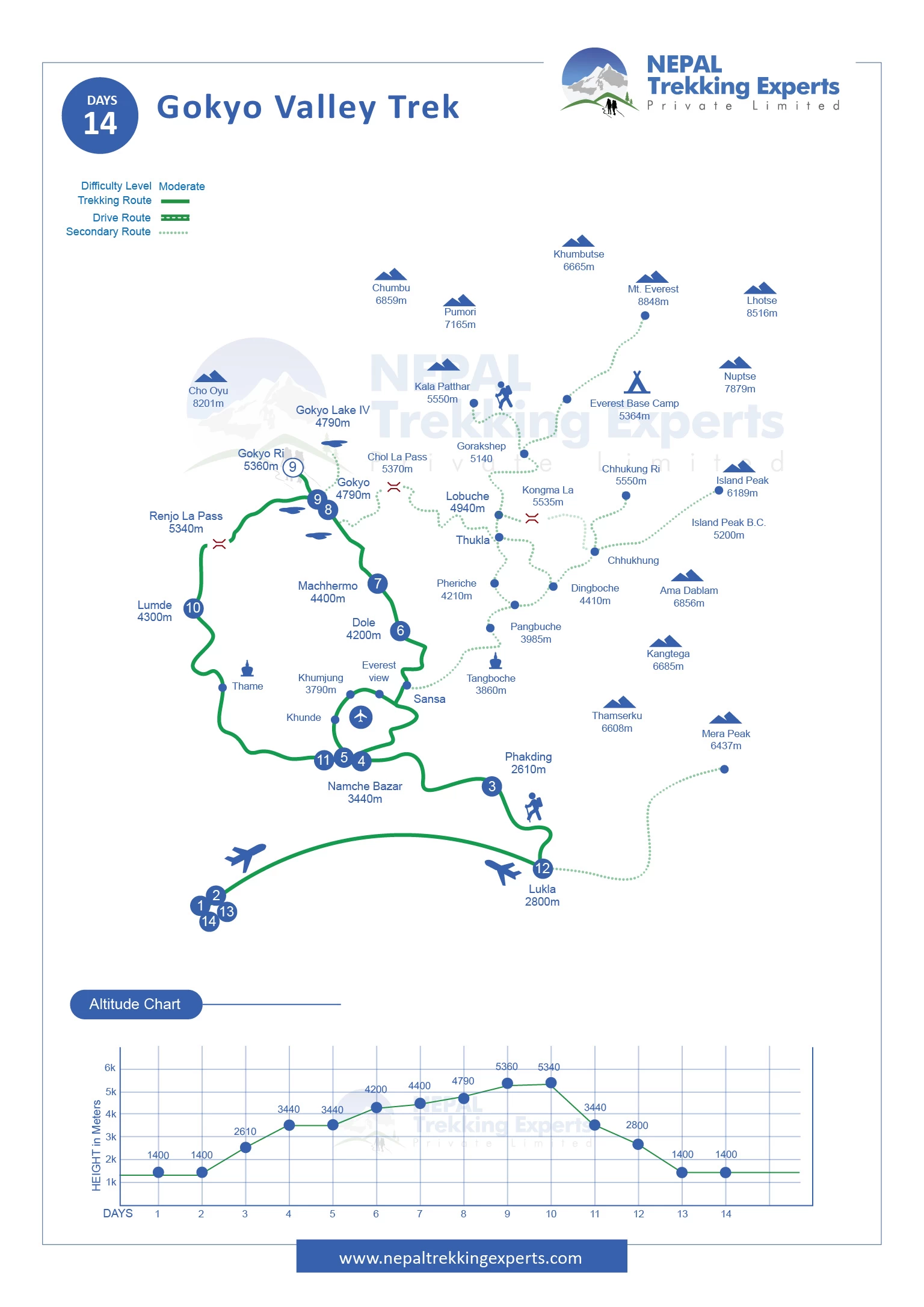
Route MapDownload Map
Gokyo Valley Trek map
Dates & Availability
Start:SaturdayAug 15, 2026
End:FridayAug 28, 2026
PriceUS$1490
StatusGuaranteed
Start:SaturdayAug 22, 2026
End:FridaySep 04, 2026
PriceUS$1490
StatusGuaranteed
Start:SaturdayAug 29, 2026
End:FridaySep 11, 2026
PriceUS$1490
StatusGuaranteed

Note

Are you satisfied with the group departure dates? Aside from that, we organize private trips or any special dates you prefer. Let's talk to our local specialist now.

Photos & Videos
FAQs for Gokyo Valley Trek
  • Gokyo Valley is in the Khumbu region, inside Sagarmatha National Park, northwest of the main Everest Base Camp route.

  • Gokyo Ri stands at 5,360 meters / 17,585 feet above sea level.

  • Most standard itineraries take 12 to 14 days, including acclimatization and travel to and from Lukla.

  • The Gokyo Valley Trek costs around USD 1490 for a standard package with Nepal Trekking Experts.

  • The Gokyo trek is generally rated moderate to challenging due to the high altitude and several long trekking days.

  • Gokyo Tso is located at approximately 4,790 meters / 15,715 feet.

  • The cost for Lukla's flight is different as per the nationalities, which is as below:

    For Nepali – Rs 6500 per person each way

    For Indians – USD 130 per person each way

    For foreigners (European, American, Australian, Chinese, etc.) – USD 217 per person each way.

  • Yes. Many itineraries include Renjo La Pass (5,360 meters), which is one of the famous Everest Three Passes.

  • Yes, solo trekking is possible in the Everest region, but hiring a licensed guide is highly recommended for safety, navigation, and local support.

  • Yes. The trek reaches above 5,000 meters, so proper acclimatization, hydration, and a gradual pace are important.

  • Gokyo Ri is 5360 meters/17585 feet above sea level.

  • You need the Sagarmatha National Park Permit and the Khumbu Pasang Lhamu Rural Municipality Permit.

  • You can expect a maximum of 20°c in the first few days and a minimum of –-15°c during the night out of the room in the high-altitude areas.

  • Gokyo is often preferred by trekkers seeking fewer crowds, turquoise glacial lakes, and panoramic mountain views, while Everest Base Camp is famous for reaching the base of the world’s highest mountain.

  • The best time for Gokyo trekking is September to November and March to May. Despite that, if you have good gear you can trek in December, January, and February as well.

  • Yes. Gokyo Ri offers one of the best panoramic views of Mount Everest, along with Lhotse, Makalu, and Cho Oyu.

You may also like
Related Packages
5Travelers' Reviews
  • TripAdvisor
    rating star

    Gokyo Valley Trek with Nepal Trekking Experts

    We took the 12 day Gokyo Lakes loop trek in the Everest region with Bikesh as our guide. It was amazing!! Nepal Trekking Experts is a first class operation! Trekking in the Everest region can go smoothly but when things get tough with weather, health, delays or logistics you want someone working with you who knows the area. All of those things and more can happen on these treks. In our case getting in and out of Lukla airport was tough. On our way out all flights were cancelled for two days when we got to the airport. Our guide and the owner, Rajesh, worked with their contracts in Lukla to get us on a helicopter out. It cost some extra but we got out the same morning ahead of many others who had been waiting overnight. Without them it’s likely we would have spent the night in Lukla. Worth every penny and the helicopter was fun. Highly recommend these guys!

    D
    David HJun 08, 2025United States
  • TripAdvisor
    rating star

    Gokyo trek

    निर्भयी भव:| (Be fearless) is a very serene blessing we all seek from our elders in the Indian culture. My wife Saritha & I had a chance to experience it last week when the Himalaya blessed us. The ‘Gokyo Trek’ in Himalaya is a 5000m+ climb. The nature's display of green jungle, freshwater gushing, world’s top mountain tips front of us (Everest, Lhotse, Makalu), heavy snow, winds spouting… We could not ask for any better larger than life portrait. One of the best life experiences.
    The full credit of this great experience to Rabin & Rajesh. Rabin was our tour guide and companion. Rajesh organized everything perfect and especially some of the facilities in the rough weather conditions.

    N
    Nilesh AJul 22, 2023India
Call us on WhatsApp+977 9841917136OrChat with us
Consult with a Travel Expert

Do you have any questions about the trips? Contact our travel experts in various countries.

Plan Your TripJoin Our Newsletter